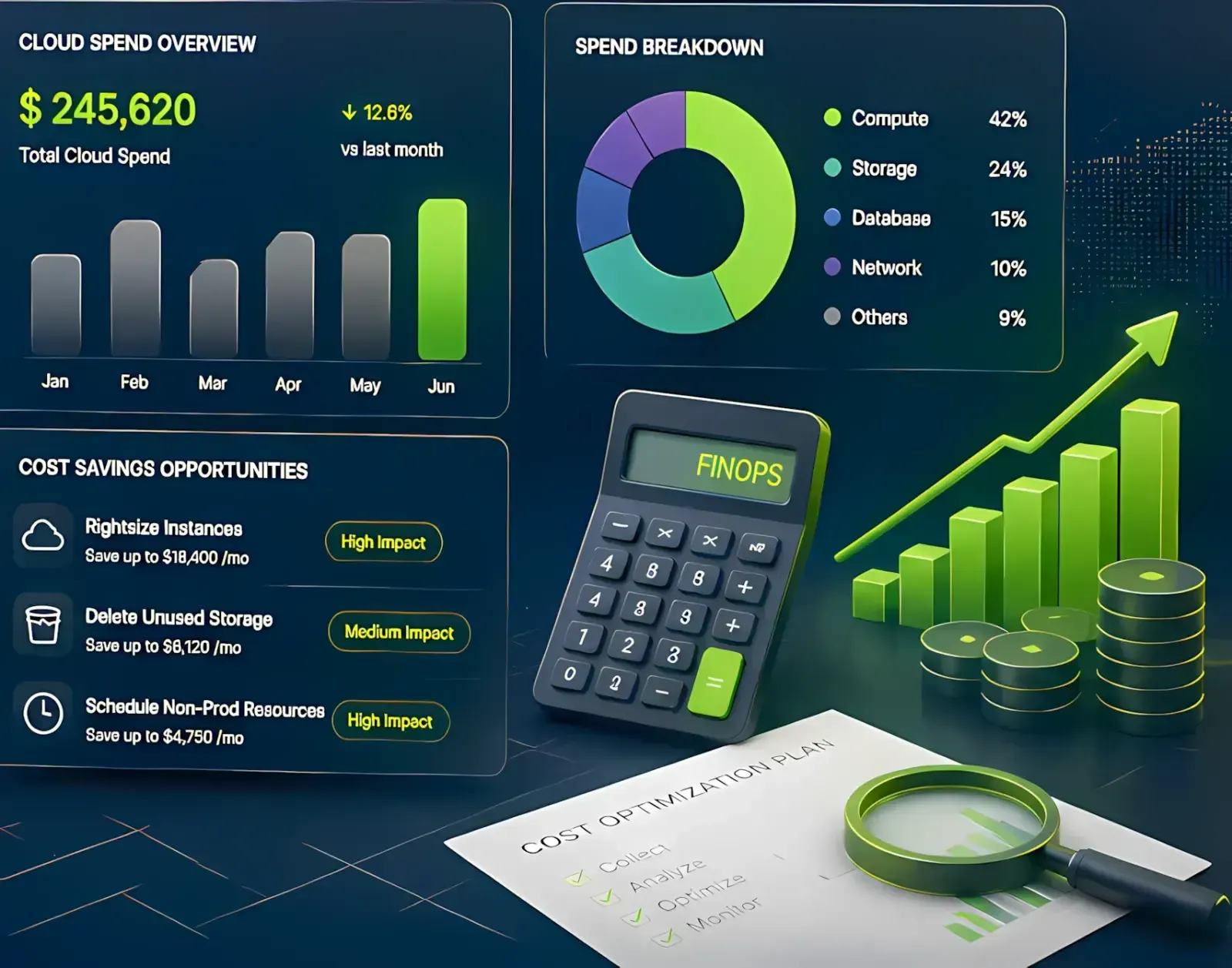
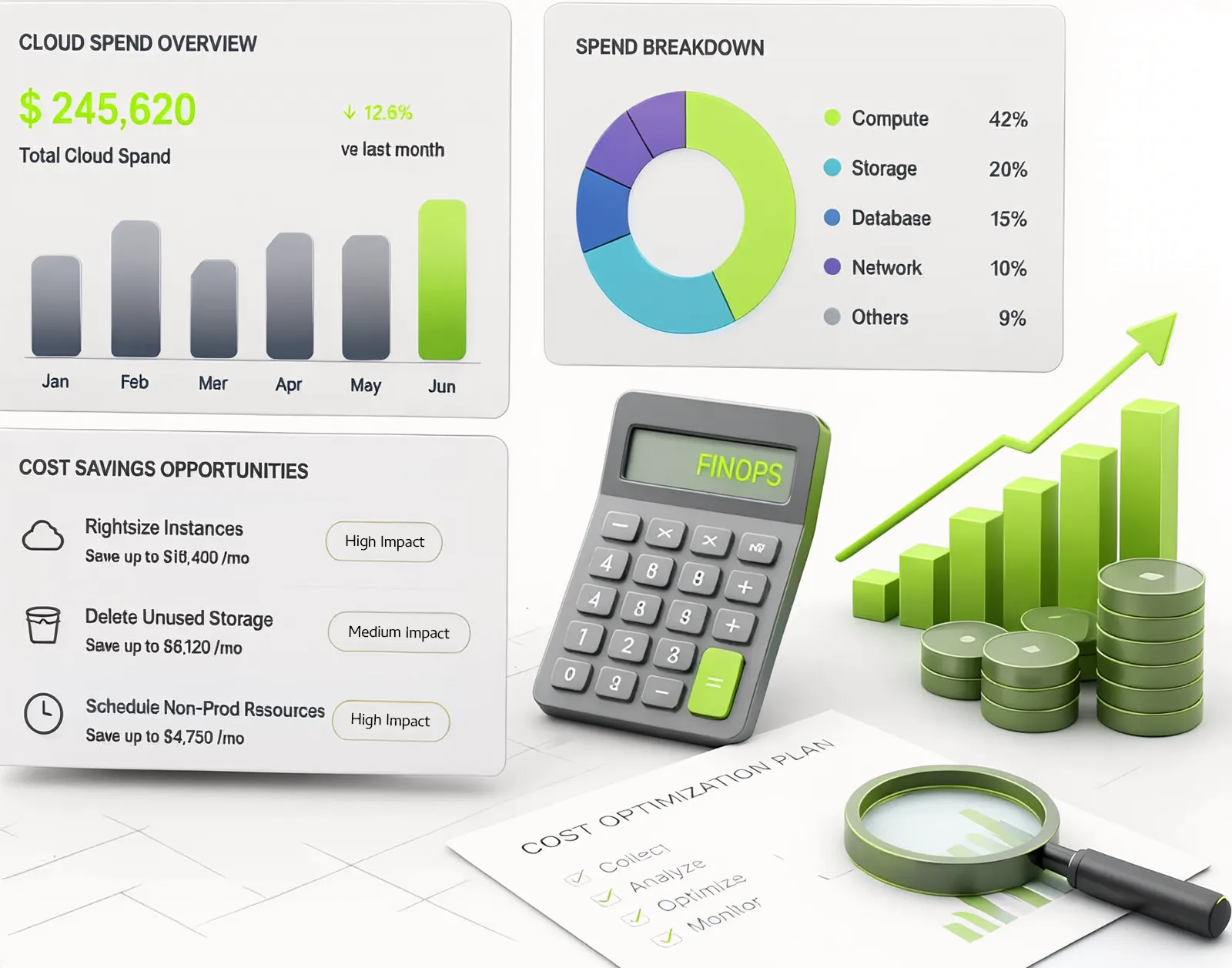
Most cloud bills aren't inflated by one big mistake — they're inflated by dozens of small, invisible ones forgotten test instances, over-provisioned databases, unused storage snapshots, and pricing tiers nobody revisited after go-live. Our Cloud Cost Optimization and FinOps services in Dubai exist to surface every one of those leaks and turn cloud spend into a controlled, predictable line item instead of a monthly surprise.
Engineering teams optimize for uptime and performance, not cost — and that's exactly how it should be. But without a dedicated financial operations layer watching spend in real time, waste compounds quietly. By the time finance notices the bill has doubled, months of unnecessary spend are already gone. FinOps closes that gap by making cost a shared, visible responsibility across engineering, finance, and leadership.
We map every dollar of spend to specific teams, projects, and services, replacing vague monthly totals with granular accountability.
Compute, storage, and database resources are matched to actual usage, and orphaned resources are decommissioned.
Reserved instances, savings plans, and committed-use discounts are structured around your real usage patterns, not guesswork.
Automated budget alerts, anomaly detection, and monthly review cycles keep spend disciplined long after the initial cleanup.
Enterprises across Dubai’s finance, retail and logistics sectors run lean margins, where unnecessary cloud spend directly erodes profitability. Our clients typically recover 20–35% of previously wasted cloud spend within the first two billing cycles, without touching performance, reliability, or the roadmap their engineering teams are already committed to. Cost optimization isn’t a one-time audit. It’s an ongoing discipline. We build the systems and reporting that keep your cloud spend accountable long after our engagement begins. What is cloud cost optimization? Cloud cost optimization is the practice of reducing what you pay for AWS, Azure or Google Cloud without reducing the performance or reliability your applications need. It combines right-sizing resources, removing idle ones, choosing better pricing models, and putting reporting in place so spend stays visible and owned by the right teams. In practice, it is a mix of engineering work and financial governance, often called FinOps. Where cloud waste usually comes from Most overspend isn’t one big mistake. It’s accumulated small decisions that nobody revisits. In Dubai and wider UAE environments, we most often find compute sized for a peak that rarely happens, and idle resources such as unattached storage volumes, old snapshots, unused load balancers and forgotten test environments. We also see steady workloads running at on-demand prices instead of Savings Plans, Reserved Instances or committed use discounts, and development and staging systems left on around the clock when they only need to run during working hours. Storage and data transfer add to the bill when rarely accessed data sits in expensive tiers or when avoidable cross-region and internet egress charges pile up. Kubernetes clusters without autoscaling, or with poorly set resource requests, leave nodes mostly empty. Underneath all of these is often a lack of ownership spend with no tags, no budgets and no one accountable, so waste goes unnoticed for months. How our cloud cost optimization process works We start with a cost and usage review, analyzing your billing data, utilization metrics and architecture to find where money is going and why. From that we build a prioritized savings plan that ranks opportunities by savings, effort and risk, so quick wins are separate from longer changes. We then implement changes in agreed stages, testing against your performance and uptime targets and coordinating with your engineering team’s roadmap. Alongside this, we set up tagging, budgets, alerts and dashboards so each team can see and own its spend. Monthly reviews catch new waste and track savings against the baseline. Why this matters for Dubai’s key sectors In finance, strict uptime and security requirements make it tempting to over-provision, so we reduce cost while keeping resilience and audit readiness intact. In retail and e-commerce, traffic spikes during campaigns, Ramadan and sale seasons call for autoscaling and scheduled capacity, instead of paying for peak capacity all year. In logistics, data-heavy tracking and analytics workloads benefit from storage tiering, workload scheduling and smarter data transfer design. Why work with a local provider A regional partner offers support hours that overlap with the Gulf business week, familiarity with UAE cloud regions and data residency considerations, and billing and communication that suit regional teams. What results to expect Our clients typically recover 20–35% of previously wasted cloud spend within the first two billing cycles. Actual savings depend on your starting point, environments that have never been reviewed usually see more, and those that already run efficiently see less. We agree on a baseline before we start, so savings are measured against real numbers.
Common questions about Cloud Cost Optimization and FinOps Services Dubai.
A.Cost optimization is the technical work of reducing waste. FinOps is the broader operational practice -combining tooling, reporting, and cross-team accountability — that keeps costs optimized continuously.
A.Savings vary by environment, but most engagements recover 20–35% of prior wasted spend within the first two to three months.
A.No. Optimization targets waste and inefficiency, not the resources your applications actually need to run reliably.
A.We work across AWS, Azure, and Google Cloud, including multi-cloud and hybrid environments common among Dubai enterprises.
A.An audit identifies waste once. Our FinOps model builds ongoing governance - budgets, alerts, and reporting — so savings are sustained rather than temporary.
Explore More
Tell us about your project and our team will get back to you to map out the fastest path to a secure, scalable solution.