
11/4/2026
How AI Agents Are Changing DevOps in 2026
DevOps is evolving rapidly as businesses adopt artificial intelligence to improve software development, deployment, monitoring, and cloud operations. In 2026, AI agents in DevOps are becoming an important part of this transformation.
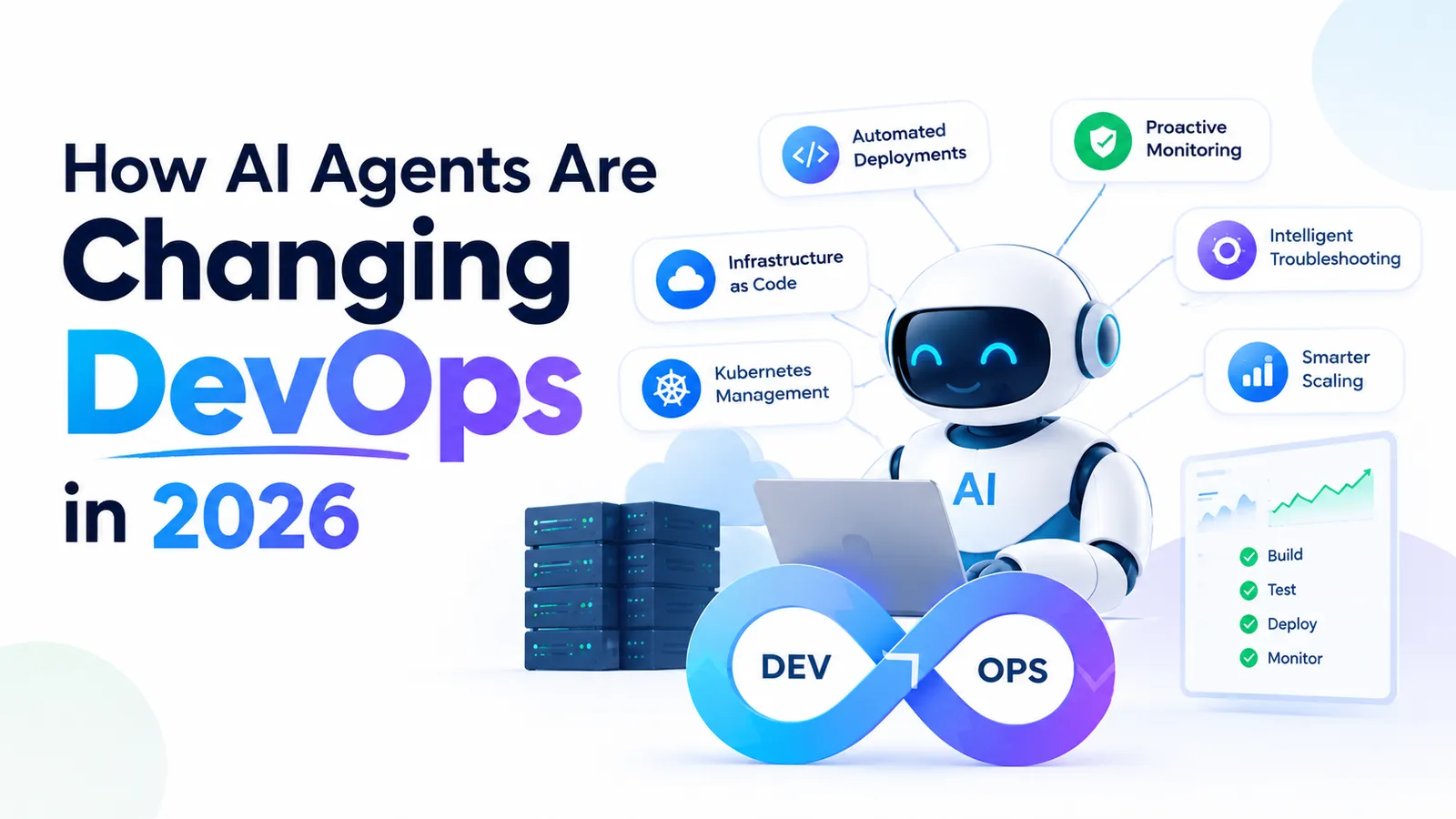
Unlike traditional automation that follows predefined rules, AI agents can understand goals, analyze information, plan multi-step tasks, and take actions with appropriate human oversight. This is opening new possibilities for DevOps automation, CI/CD, cloud management, monitoring, and software delivery.
What Are AI Agents in DevOps?
AI agents are intelligent software systems that can analyze data, make decisions, and perform tasks to achieve a defined objective. In a DevOps environment, an AI agent can work with CI/CD pipelines, cloud infrastructure, monitoring platforms, logs, testing tools, and development environments. For example, when a deployment fails, an AI agent could analyze logs, identify a potential configuration problem, recommend a solution, and support the recovery process. This makes AI agents more capable than traditional scripts because they can use context and reasoning to handle more complex workflows.
How AI Agents Are Transforming DevOps
1. Intelligent Incident Detection Modern applications generate enormous amounts of logs, metrics, and alerts. Manually reviewing all this information can consume significant engineering time. AI agents can analyze operational data, identify unusual patterns, prioritize alerts, and help engineers investigate incidents faster. This can support more proactive DevOps monitoring and incident management.
2. AI-Powered CI/CD
AI agents can make CI/CD pipelines more intelligent by analyzing code changes, test results, build failures, and deployment history. For example, an AI system can identify recurring test failures, explain potential causes, and recommend corrective actions. AI-assisted CI/CD can reduce repetitive work while helping development teams deliver software more efficiently.
3. Cloud Infrastructure Optimization
Cloud environments can become complex as applications scale across services and regions. Managing resources manually can also lead to unnecessary cloud spending. AI agents can analyze resource usage and identify opportunities for optimization. For businesses using AWS, Azure, or other cloud platforms, AI assisted operations can support resource optimization, infrastructure monitoring, and cloud cost optimization
4. Faster Troubleshooting
Troubleshooting often requires engineers to examine application logs, infrastructure metrics, deployment records, and configuration files. AI agents can bring information from multiple systems together and analyze it in context. This can help engineers identify potential root causes faster and reduce the time spent on repetitive investigation.
5. Infrastructure Automation
Infrastructure as Code (IaC) has already transformed infrastructure management. AI agents can extend this approach by assisting with infrastructure configuration, validation, documentation, and optimization. However, production changes should still follow appropriate approval processes. Human review, access controls, testing, and monitoring remain important when AI systems interact with critical infrastructure.
AI Agents vs Traditional DevOps Automation
Traditional automation and AI agents operate on fundamentally different paradigms:
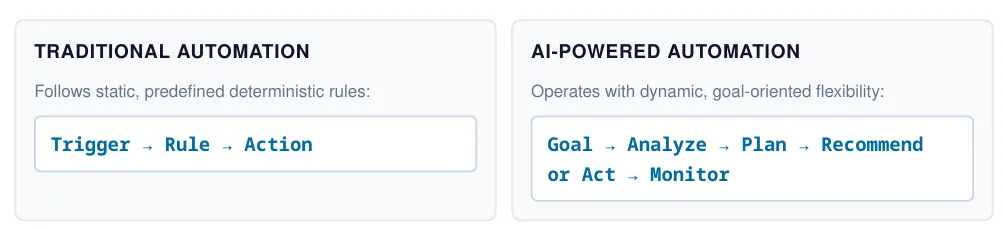
This does not mean traditional automation is becoming obsolete. Instead, AI agents can complement existing automation by handling tasks that require analysis, context, or decision-making.
Security and Human Oversight
As AI agents gain access to development and cloud environments, security becomes increasingly important. Organizations should consider:
Least-privilege access
Identity and authentication
Human approval for high-risk actions
Audit logs
Monitoring and observability
Secure tool and API access
Clear governance policies
Current 2026 discussions around agentic infrastructure emphasize that organizations need strong controls as AI systems gain greater operational capabilities. The goal should not be to give an AI agent unlimited access. Instead, businesses should define what an agent can see, what it can change, and when human approval is required.
What Is the Future of AI-Powered DevOps?
AI agents are moving beyond simple coding assistance toward broader software delivery and cloud operations. Industry research in 2026 highlights growing adoption of AI agents for cloud engineering, platform engineering, observability, and operational workflows. The future of DevOps is therefore likely to be AI-assisted rather than completely autonomous. Engineers will continue to provide architecture, strategy, governance, and oversight while AI handles more repetitive analysis and operational tasks.
How 2Cloud Can Help
Businesses looking to adopt AI-powered DevOps need more than an AI tool. They need the right combination of cloud infrastructure, automation, software development, security, testing, and cost optimization. 2Cloud provides DevOps and cloud services, AI development, AWS and serverless solutions, enterprise software development, iOS and Android app development, cloud cost optimization, and software testing services. Whether your business needs to modernize its DevOps pipeline, automate cloud operations, integrate AI into existing workflows, optimize AWS infrastructure, or build a scalable software platform, 2Cloud can help you design and implement the right technology strategy.
Ready to Modernize Your DevOps Environment?
Contact 2Cloud today to discuss your AI, DevOps, cloud, or software development requirements and start building a smarter, more scalable technology infrastructure.
Frequently Asked Questions
What are AI agents in DevOps?
AI agents are intelligent systems that can analyze information, plan tasks, and perform or recommend actions across DevOps workflows such as monitoring, CI/CD, testing, troubleshooting, and cloud operations.
How can AI agents improve DevOps?
AI agents can reduce repetitive work, analyze large volumes of operational data, assist with incident detection, improve troubleshooting, support CI/CD workflows, and identify cloud optimization opportunities
Will AI replace DevOps engineers?
AI is more likely to augment DevOps engineers than completely replace them. Engineers remain important for architecture, security, governance, decision-making, and managing complex production environments.
Are AI agents secure for production environments?
AI agents can be used in production, but organizations should implement appropriate access controls, monitoring, auditability, testing, and human approval for high-risk actions.
Conclusion
AI agents are changing DevOps in 2026 by bringing intelligent automation into software delivery, monitoring, troubleshooting, infrastructure management, and cloud optimization. The most effective strategy is not to automate everything. Businesses should identify processes where AI can provide measurable value while maintaining security, governance, and human oversight. For organizations planning the next stage of their DevOps and cloud transformation, combining AI automation with strong DevOps practices can create a more efficient, scalable, and resilient technology environment.